

Players will be shown the red card if they cover their mouths with their hands in a ‘confrontational’ situation. That’s just one of a host of new rules introduced by the International Football Association Board (IFAB), football’s ruling party, ahead of the World Cup. They will remain in place across world football thereafter.
IFAB have been working with a range of stakeholders, including FIFA referees chief Pierluigi Collina, in a bid to ‘tackle discrimination, cut time-wasting, increase match tempo and improve fan and player experience.’ To mark your card, here’s an overview of the incoming changes:
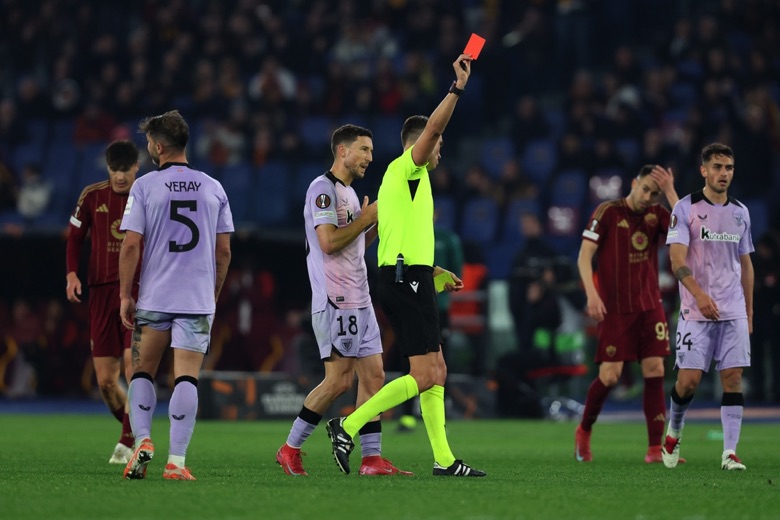
- A red card will be shown to players covering their mouths during confrontational situations
- A red card will be shown to players leaving the field in protest at a referee’s decision
- VAR can now overturn corner kicks given incorrectly
- Players receiving treatment from the physio on the pitch will need to leave the field for at least one minute before they can return
- A ban on grappling and blocking at set pieces
“We are trying to clean the game as much as possible,” Collina commented. These new guidelines will be introduced for the first time at the World Cup, before being rolled out across the Premier League, EFL and other major competitions around the globe.
Red Card for Mouth Covering
Very much a modern football phenomenon, players have been covering their mouths for a number of seasons now in a bid to evade lip-reading professionals. There is the potential for serious ramifications, however, if a player is covering their mouth with their hand and saying something that is, perhaps, racist, homophobic or offensive in any way.
That was the case when Real Madrid’s Vinicius Jr alleged that he was racially abused by Benfica’s Gianluca Prestianni during a Champions League game in 2025/26. Prestianni had covered his mouth with his shirt, which ultimately meant that there was no clear evidence of what exactly was said – he denies making any racist comments.
The Argentine was subsequently cleared of racism, however he was charged with making a homophobic comment and banned for six games. Listed on the official rollcall of red card offences in football is ‘using offensive, insulting or abusive language and/or actions.’
Clearly, covering one’s mouth could be perceived as an attempt to prevent abusive language from being detected – especially in games that are hot tempered and feisty. IFAB have clarified the new rule by attaching it specifically to ‘confrontational situations’, where such flashpoints are more likely to unfold.
A player will be allowed to cover their mouth when the conversation is more genial in nature; although that is worryingly subjective. “If it is a friendly conversation, they can continue to do it without any problem,” Collina said. “When it is confrontational, it is a completely different story. Covering the mouth means you are doing something potentially very wrong.”
Red Card for Leaving the Field in Protest
Cast your mind back to the AFCON final of 2026, when Senegal walked off the field in protest over a penalty awarded to Morocco. It created almighty controversy, with the players remaining off the field for more than 15 minutes. The game eventually resumed, with Senegal ultimately going on to win via a penalty shootout.
However, that result was eventually overturned by CAF, the regulatory body of African football, who deemed the walk off enough to merit a forfeiture and an administrative 3-0 victory for Morocco. It was an embarrassing turn of events for what is one of international football’s most important games – embarrassing enough, it transpires, for an IFAB rule change.
The only possible problem is if players do leave the field in protest. Now, they will be red carded… will the referee send off a whole team if they all exit the pitch in this way? “Any team that causes a match to be abandoned will, in principle, forfeit the match,” read the new guidelines.
VAR to Overturn Incorrectly Awarded Corners
Given the number of goals that are scored from set pieces these days, every corner can be the difference between winning a game and otherwise. And so it’s vital that corners are correctly given… and overturned when given incorrectly.
The remit on VAR has been expanded to include corners. Previously, video officiating had been limited to goals, penalties and red card incidents. A corner decision can now be reversed by VAR, but it must be done immediately without causing a delay to the restart. The new rule does not extend to reversing a goal kick that should have been given as a corner.
Although there’s no specific time limit in which decisions must be reversed, Collina has been very keen to stress the importance of ‘tempo’. Any VAR review must be conducted in a way that doesn’t disrupt the natural flow of a game.
Ban on Grappling and Blocking at Set Pieces

It has been one of the conversational hot potatoes of the 2025/26 season. But the constant grappling and blocking at corners in particular could become a thing of the past thanks to a new IFAB ruling. The new guideline prevents any such physical contact to be committed before the set piece is taken. If grappling is witnessed by the match officials, the corner or free kick will have to be retaken.
Unveiling the rule, Collina referenced a very specific moment in a game between England and Uruguay in March. In that Wembley contest, one England corner saw Adam Wharton deliberately run into Uruguay’s Jose Maria Gimenez in a blocking motion – before Cole Palmer whipped in a delivery that ended up with Ben White scoring. Collina remarked:
The incident at Wembley was very serious. The ball was not in play and there was a clear foul committed by an illegal block against the defender.
That block was the only projected threat preventing the defender from being able to defend on his opponent… we are convinced that this goal cannot stand. It is completely unfair.
